October 13, 2026
Rocky is the AI agent that Eco Combustion Europe is integrating into its control platform...


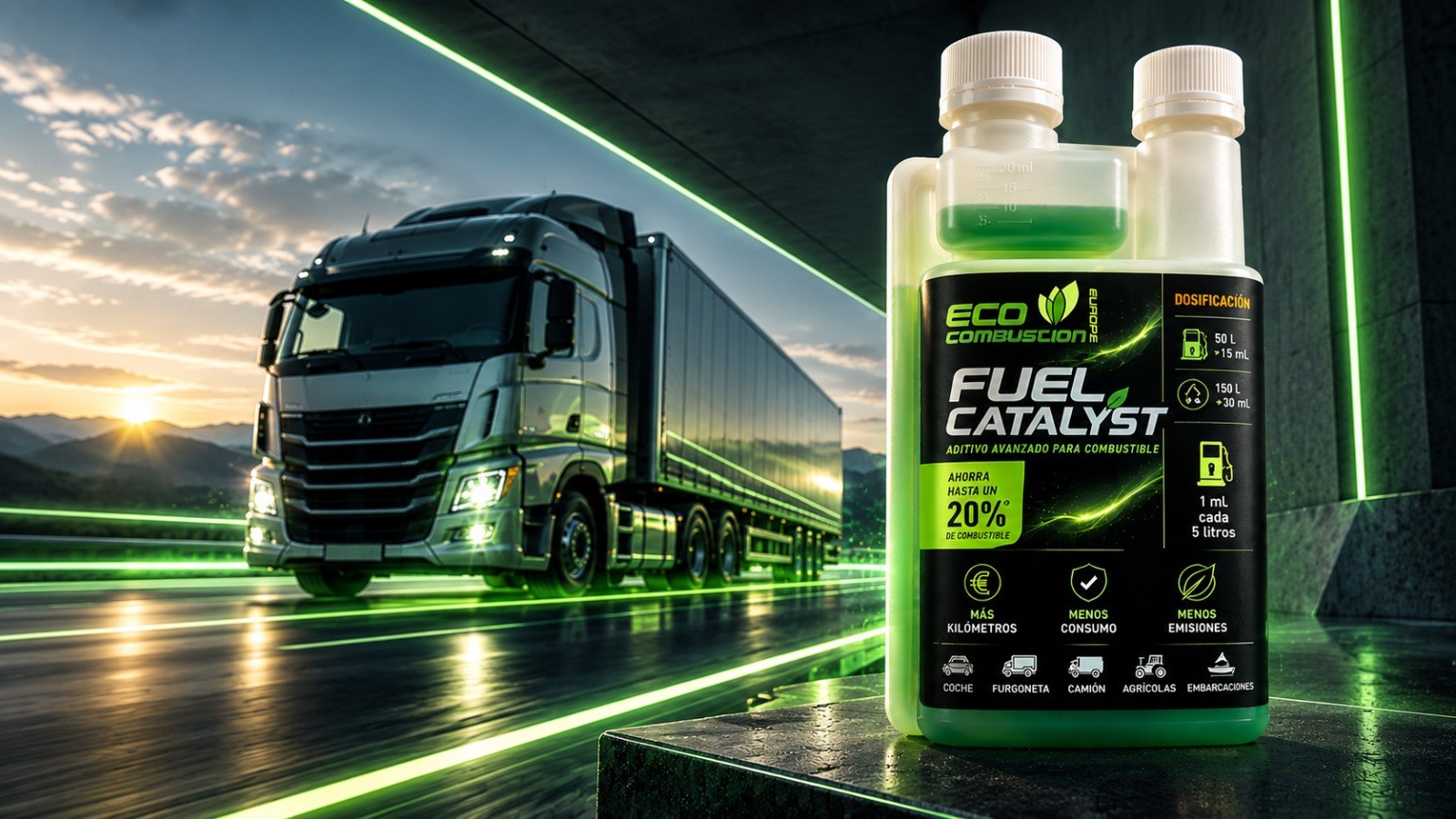
A 6,193 km trial in a diesel tractor truck demonstrates an efficiency improvement of up to 13.5%. In real-world applications, Fuel Catalyst It can exceed 13% fuel savings and reach up to 20%, without modifying the engine.
More kilometres per litre of fuel. Lower operating costs. No engine modification required.
Reducing the fuel consumption of a fleet does not necessarily require replacing vehicles, modifying engines, or altering daily operations.
Fuel Catalyst acts directly on the fuel to favour more efficient combustion and makes better use of the energy available in each litre.
In real applications, when properly dosed and monitored, Fuel Catalyst It can generate fuel savings of more than 13%, reaching values of up to 20 % depending on the vehicle, engine condition, fuel, load, route and operating conditions.
A recent trial conducted in Mexico with a diesel tractor truck demonstrates the potential of the technology in one of the most demanding scenarios possible: heavy-duty transport, high-mileage vehicle, variable load and real-world operation.
The vehicle used was a 2016 Kenworth tractor-trailer with more than 1.1 million kilometers, operating on its usual route between Hermosillo and Agua Prieta and intended for the transport of livestock.
It was not a laboratory test or a course of action designed to achieve a favorable result. During the trial there were:
Precisely for this reason, the results are especially relevant.
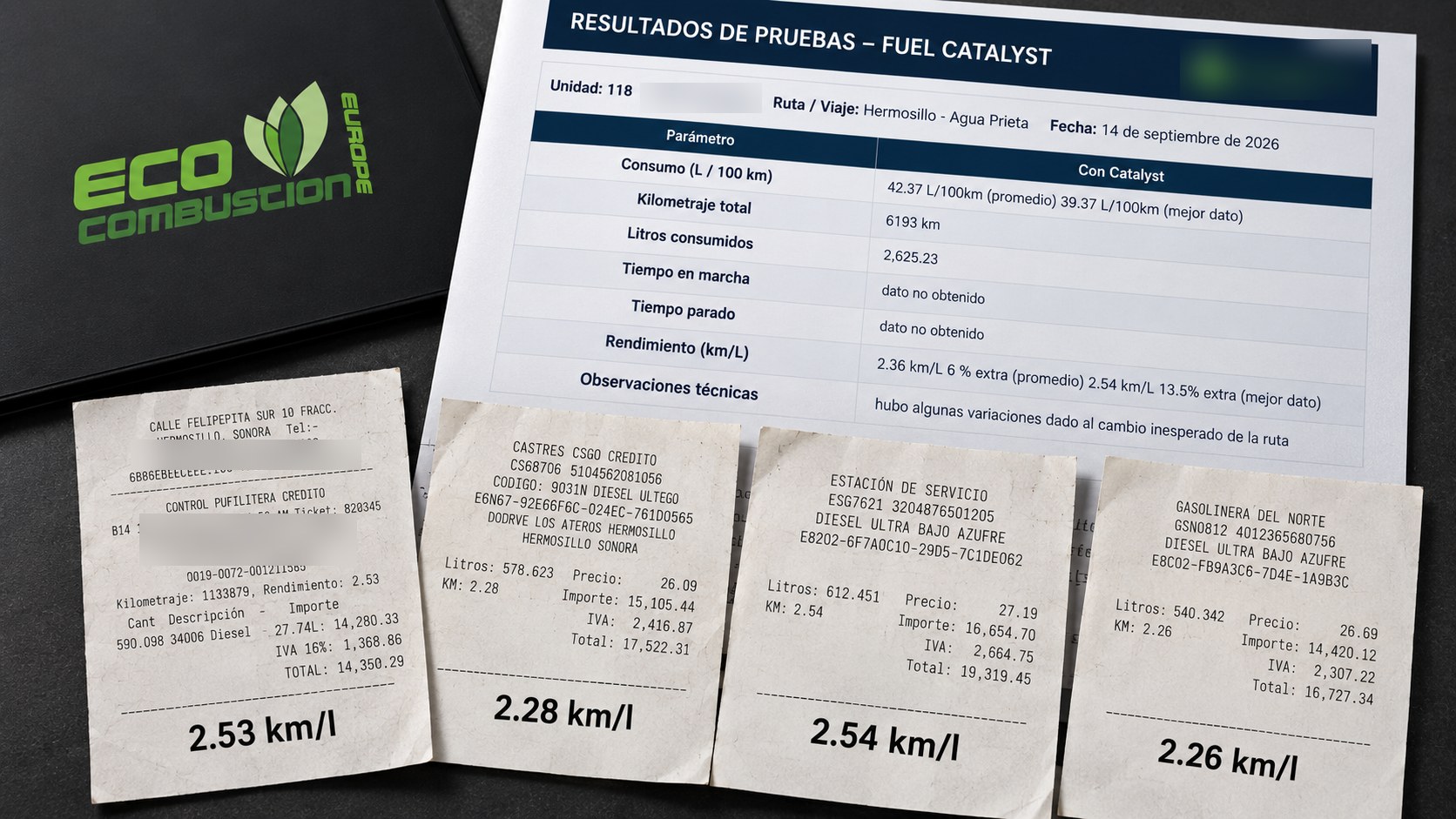
During the monitored period, 6,193 kilometers were traveled, consuming approximately 2,625 liters of diesel.
The average recorded performance reached 2.36 km/L, while the best performance achieved reached 2.54 km/L, representing an improvement of 10%. 13.5% efficiency improvement Regarding the reference value used in the trial.
| Indicator | Result |
|---|---|
| Distance traveled | 6,193 km |
| Diesel consumed | 2,625 L |
| Average consumption | 42.37 L/100 km |
| Best recorded consumption | 39.37 L/100 km |
| Average performance | 2.36 km/L |
| Average performance improvement | +6 % |
| Better performance | 2.54 km/L |
| Maximum improvement in performance | +13,5 % |
These results were obtained on the road and during the vehicle's normal operation, documenting refueling, mileage, and consumption.
Yes.
The experience gained from different applications demonstrates that, when the conditioning process of the fuel system is completed and comparable evaluation conditions are maintained, Fuel Catalyst It can exceed the 13% reduction in consumption, with savings of up to 20% being achievable in certain fleets and operating conditions.
It is important to understand that a motor with many kilometers does not necessarily reach its maximum potential from the first tank.
Fuel Catalyst It acts progressively on the fuel system and combustion. For this reason, we recommend evaluating its performance over several complete refueling cycles and comparing sufficiently representative periods.
The goal is not to achieve an exceptional result during a single trip. The goal is to sustainably reduce the cost per kilometer of the fleet.
In heavy transport, even a relatively small reduction in consumption can represent a significant amount of fuel at the end of the year. But when the improvement exceeds 10-13%, the economic impact changes in scale.
Real case with signed report: URBASER Bahrain. The waste management multinational confirmed a 10–12% fuel savings with Fuel Catalyst, After more than five full deposits and under the supervision of his Fleet Manager. View the case in Results
For example, a fleet that consumes 1,000,000 liters of diesel per year:
That's why Fuel Catalyst It should be evaluated not as the cost of an additive, but as a tool to reduce the energy cost of the operation.
The higher a company's annual fuel consumption is, the greater the economic impact of improving its efficiency by just a few percentage points can be.
During the test, operational improvements related to the combustion process were also observed:
The principle is simple: If a greater proportion of the fuel is converted properly into useful energy, less fuel is needed to perform the same work.
In addition to direct savings, more efficient combustion can help keep the injection system cleaner and reduce the formation of waste products resulting from poor combustion.
Fuel Catalyst It is a catalytic treatment of the fuel that is incorporated directly into the tank. It does not require any modifications:
It also does not require the vehicle to be immobilized.
The technology is designed to improve the characteristics of the fuel and favor a more efficient atomization and combustion process.
Fuel Catalyst It is also registered with the U.S. EPA under number 273720001.
Its application can be carried out on individual vehicles or on entire fleets, and the result can be verified using the customer's own operational data.
At ECO COMBUSTION EUROPE we do not propose that the customer simply believes that the product works. We propose to measure it.
To do this, we can develop a pilot test using vehicles from the customer's own fleet and compare:
When CANBUS/FMS telemetry is available, we can additionally incorporate parameters such as:
In this way, saving ceases to be a perception and becomes a reality. Verifiable economic KPI.
Each engine and each operation are different. Therefore, we do not recommend automatically extrapolating a single percentage to any vehicle.
However, the results obtained in real applications show that Fuel Catalyst It can exceed 13% of savings and, under favorable conditions, approach 20% of consumption reduction.
The correct way to know the potential outcome in a company is simple: Test it out on your own vehicles.
If your company operates trucks, buses, municipal machinery, mining machinery, generators, industrial vehicles, or equipment that consumes significant amounts of diesel or gasoline, we can analyze your operation and calculate the economic potential. Fuel Catalyst.
We selected several representative vehicles, established a baseline consumption figure, and applied it. Fuel Catalyst And we monitor its evolution. The customer can directly see how many liters they used before, how many they use after, and how much money the difference represents.
The fuel that generates the most profitability is the one that is no longer necessary to consume.
Requests a pilot test of Fuel Catalyst or write to us at central@eco-combustion.comECO COMBUSTION EUROPE
We measure. We optimize. We demonstrate the savings.
Rocky is the AI agent that Eco Combustion Europe is integrating into its control platform...

Norway presents itself as the great success of electric mobility, but its model is based on...